
Consumer Reports
Connie is an AI shopping assistant browser extension that combines Consumer Reports' lab data, real community sentiment, and a shopper's own values into personalized product insights—helping people shop with confidence, wherever they're already browsing. It's a 7-month capstone built in collaboration with Consumer Reports, a nonprofit known for its independent, unbiased product testing and a mission to put power back in consumers' hands.
Skills
0 → 1 Product Design
User Research
Design Strategy
TEAM
5 MHCI graduate students, cross-functional (research, design, engineering)
Timeline
7 months (Jan–July 2026)
BUILT WITH
Figma & Figma MCP
Claude Code

“There’s so much good food for thought here, especially with where the CR brand should travel to show up where people are, which is something we're consistently grappling with.”
PROBLEM
Hundreds of reviews, unclear incentives, and no easy way to know what's actually true. Consumers today are left to separate signal from noise themselves.
In late 2024, traffic to retail sites from AI chatbots spiked 2,000% as consumers turned to AI for gift ideas and product research. That shift has since evolved into agentic commerce, where algorithms can autonomously fill carts and complete purchases. But built the way the rest of the internet already works, AI shopping risks becoming just as warped by ads and persuasion.

How can Consumer Reports evolve in the era of AI and continue fulfilling their mission of protecting and empowering consumers?
As more consumers turn to AI to research products and make purchasing decisions, how can they trust that what's being recommended isn't paid placement or persuasion in disguise? Consumer Reports challenged us to imagine an alternative: consumer-first AI, designed with loyalty and intention to serve the person over the platform and help consumers buy in line with what really matters to them.
RESEARCH
Trust accumulates in small, everyday moments. Consumer Reports has earned that trust, but still needs to gain the presence necessary to meet the needs of consumers today.
WHAT WE SET OUT TO LEARN
We wanted to know whether Consumer Reports could stay relevant as AI increasingly sits between people and their purchases. If so, where in the shopping journey does CR need to show up to make that happen?
HOW WE GOT THERE
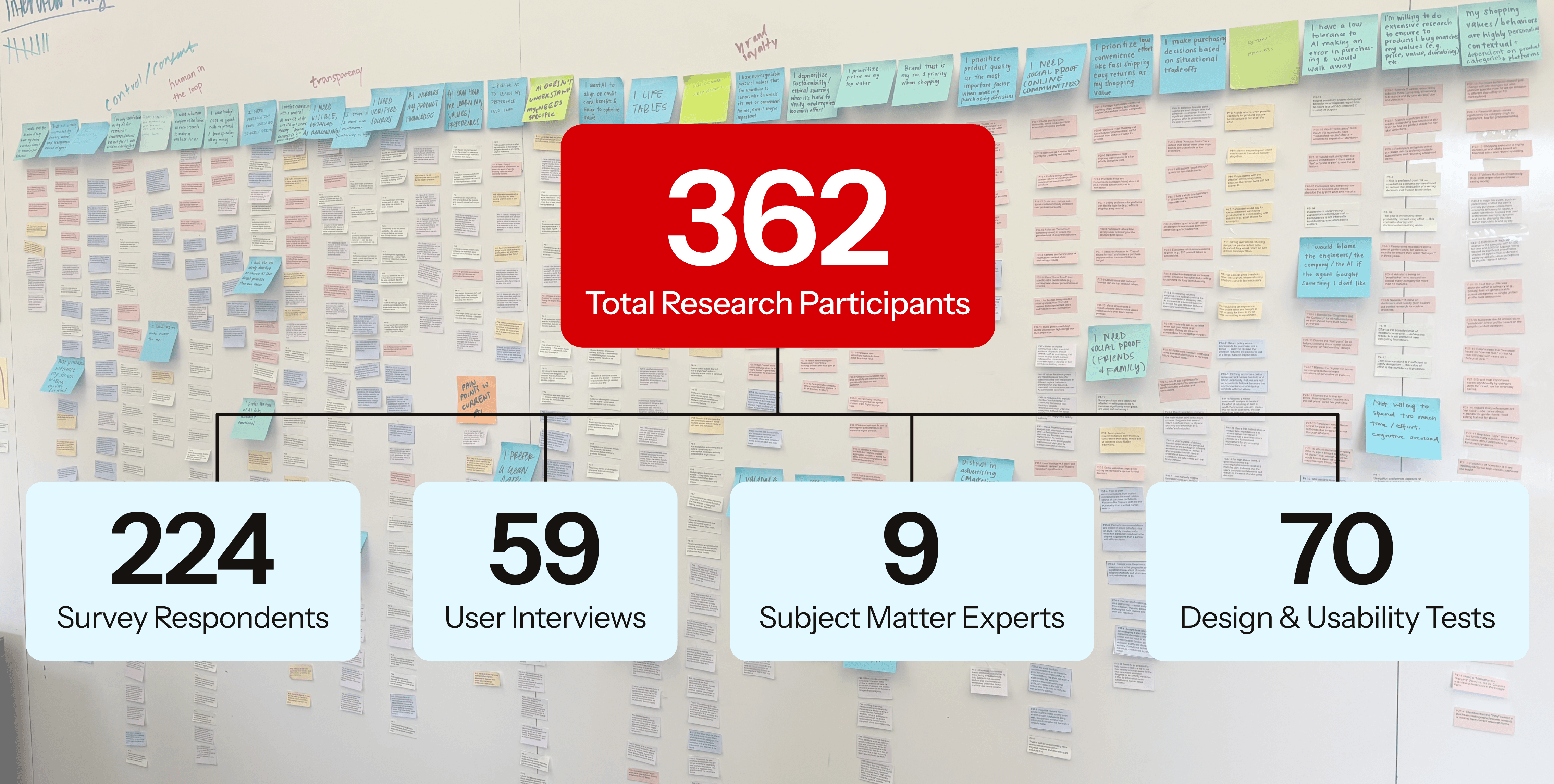
An initial survey established a baseline understanding of who we were designing for, their purchasing behaviors, and their attitude towards AI shopping. We then developed 10 distinct studies that dug into the nuances of trust, delegation, and values across the shopping journey.



KEY INSIGHTS
Discovery is where preferences actually take shape. 🔍
Especially for unfamiliar product categories, people need help figuring out what they want and what they should be looking for, not just help choosing from what they already know.
Shopping values function as identity, not just preference. 🎯
While specific preferences are discovered through shopping, the values behind them, like budget and sustainability, stay fixed. Ignoring those values breaks trust.
For millennial shoppers, trust is increasingly social. 👥
Real experiences from spaces like Reddit and YouTube have become the signal that helps them make the final purchase. CR's technical rigor needs a human companion.
People value AI as more of a thinking partner. ⚖️
74% of our participants wouldn't trust AI to buy for them. Instead, they like using it to help them discover and research products, narrow down a shortlist, and compare options.
EXPLORATION
The reframe that shaped everything from here was moving from "buy it for me" to supporting discovery.
WHAT SHOULD WE MAKE?
Our early instinct was to design an autonomous purchasing agent, but our research showed that people would rather AI think alongside them than decide for them, and a confident purchase comes from reasoning you can actually see and trust. We tested that reframe across a range of concepts, including these three:

Could an agent operate autonomously within limits the user sets?
This validated our reframe. People were only comfortable delegating within tight, reversible boundaries and expressed that full delegation took away the joy of discovery.

Could we bridge the gap between lab data and social proof?
One social proof concept pitted CR's lab data against social sentiment. Participants liked having both in one place, and they only trusted it when the sourcing was visible.

Could CR show up earlier, while people are still figuring out what they want?
Preferences aren't fixed going in, they're discovered while shopping. An assistant that only shows up at the decision point misses where people actually need help.
WHERE SHOULD IT SHOW UP?
We chose to design for millennial shoppers—a group navigating some of life's major milestones and biggest purchases, but one CR hadn't been reaching. To build presence, we needed to meet these shoppers where they already are, so we considered three forms:
Should we build a standalone agent? 🤔
Like Consumer Report's own chatbot AskCR, but this asks shoppers to stop what they're doing and come to CR, so presence depends on people remembering to leave their flow.
What about an embedded plugin? 🤔
CR is right there in the shopping flow, but it only works on retail sites. Research happens on social media, review sites, and AI search too. A plugin can't follow shoppers there.
Let's build a browser extension! 💡
CR shows up everywhere a shopper is searching, not just where they're buying. This was the only option that let CR be present across the whole shopping journey.
SOLUTION
We built Connie, an AI shopping assistant browser extension that brings trusted, independent product insights directly into a shopper's existing browsing experience.
Connie meets shoppers where they already are, combining CR's lab data with real online sentiment and the user's specific values and life context to help them shop with confidence.

FEATURES
Cut through review noise
Connie highlights top-recommended products on the retailer page with a card and reasoning combining CR's lab testing, real owner sentiment, and source visibility filtered to some user-set basic preferences. Volume was the biggest pain point in our research: people don't want to read a hundred reviews, and they don't want a rating without knowing why it was given.
Verify claims instantly
Highlight any claim on a product page, and Connie checks it against CR's lab data and real owner reports, flagging it as verified, misleading, or unconfirmed. Product information is often indistinguishable from advertising—a high score isn't enough if a shopper can't tell whether what they're reading is actually true.
Discover your preferences as you shop
Instead of a long survey, Connie starts with what typically matters for a category, then refines through a few contextual, adaptive questions. Our research found that shopping is often how people figure out what they value and prefer, especially in unfamiliar product categories.
Narrow options into a shortlist
Connie narrows hundreds of options into a shortlist, each with plain-language reasoning and links to the evidence. People consistently told us that rather than AI buying for them, they wanted the research done and the options pruned, keeping the final decision for themselves.
Pass your experience forward
Connie checks in the next time you shop a related category, asking about a past purchase. People value real, lived-in feedback—something reviews rarely capture and CR's testing doesn't have access to. Each check-in turns one person's experience into better guidance for the next shopper.
HOW IT WORKS
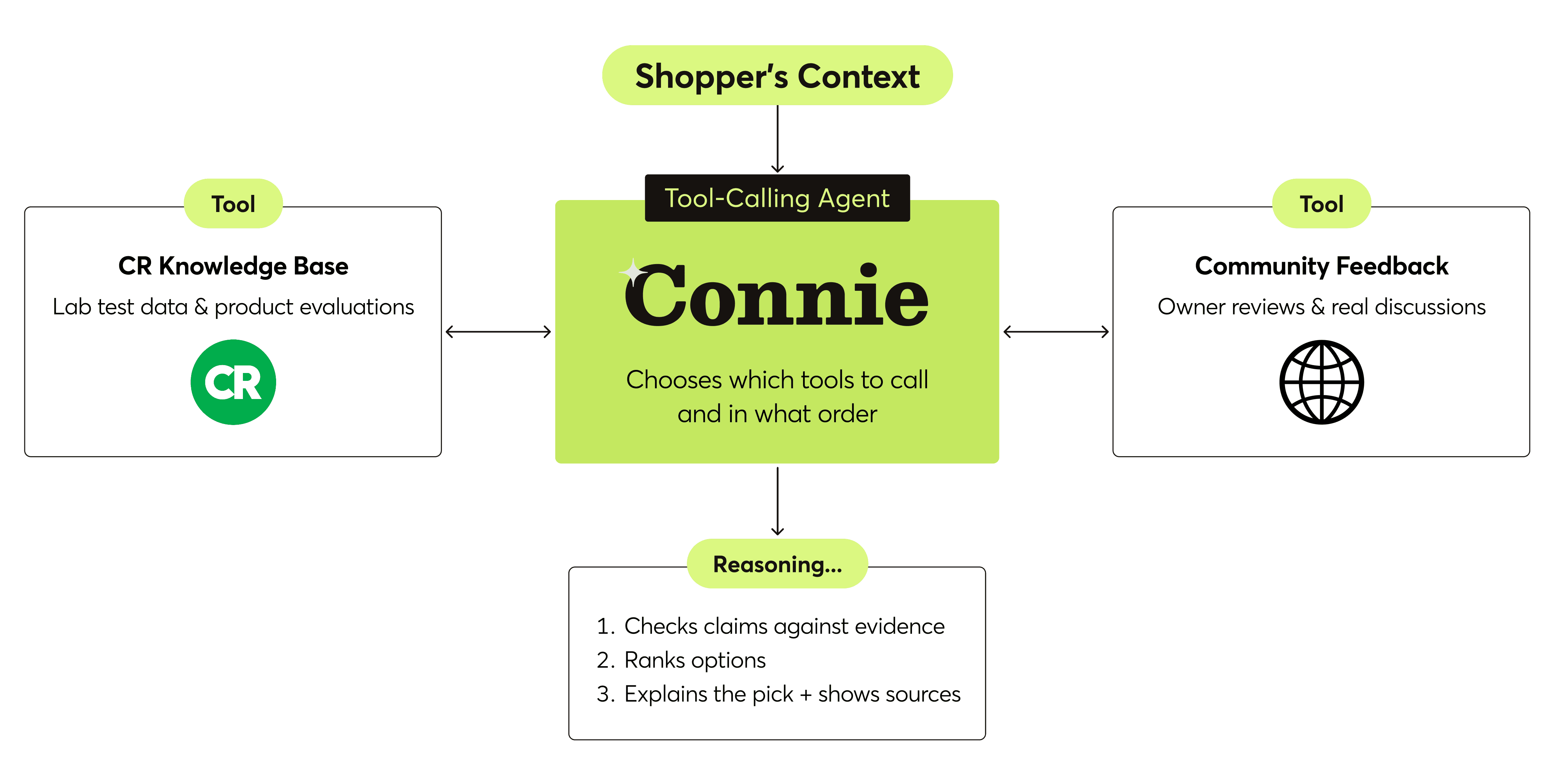
Connie runs a tool-calling agent that pulls lab data and real online sentiment, then reasons through what fits you.
It takes in the shopper's context — what they care about, what sources they trust, what's on the page — then compares the two sources, checks the page's claims against the evidence, and ranks and explains options based on the shopper's stated priorities.
IMPACT
Connie was well received by Consumer Reports, sparking a broader conversation about expanding its presence beyond its existing platform and contributing to a deeper internal initiative around their AI adoption.
We presented Connie and our research to Consumer Reports' innovation team and executives, alongside a broader proposal of three design principles for what consumer-first AI should look like:
Loyalty 🤝
Being loyal to the person over the platform and designing with the consumer's best interest at heart.
Transparency 🪟
Being clear about what the AI knows, what it doesn't, and where the data came from.
Presence 📍
Meeting consumers where they are and showing up at the moments that matter most in their shopping journey.
Every major life change comes with big purchasing decisions. Connie can show up in all of them: combining lab data and real community sentiment, weighted by what you actually care about, so you can shop with confidence, whatever the moment.